
zhimin jian a, haowen dang a, jimin yu b c, qiong wu d, xun gong e f, christian stepanek f, christophe colin g, lili hu a, gerrit lohmann f, xiaoli zhou a, sui wan h
a state key laboratory of marine geology, tongji university, shanghai, china
b laoshan laboratory, qingdao, 266237, china
c research school of earth sciences, australian national university, canberra, act 2601, australia
d college of oceanography, hohai university, nanjing, china
e hubei key laboratory of marine geological resources, china university of geosciences, 430074, wuhan, china
f alfred-wegener-institut, helmholtz-zentrum für polar- und meeresforschung, 27570 bremerhaven, germany
g université paris-saclay, cnrs, geops, 91405 orsay, france
h south china sea institute of oceanology, chinese academy of sciences, guangzhou, china
abstract:
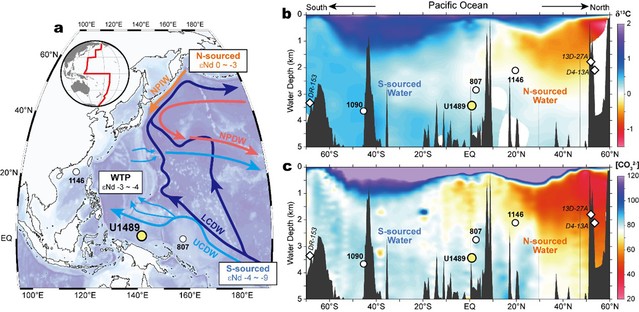
the global climate has been gradually cooling over the cenozoic and is punctuated by the intensification of northern hemisphere glaciation (nhg) from the latest pliocene to earliest pleistocene (∼3.1–2.5 millions of years ago, ma). a decline of atmospheric co2 is supposed as a prerequisite for the nhg, but the associated carbon-cycle processes remain elusive. here we combine foraminiferal records of neodymium isotope and boron-calcium ratio, and simulations of an earth system model, to investigate changes in the water-mass composition and carbonate-ion concentration of the deep pacific ocean during the nhg. our proxy records have revealed a significant expansion of southern-sourced waters with increased respired carbon storage into the deep pacific during the nhg. these changes may be explained by strengthened deep-water formation and biological-pump efficiency in the southern ocean due to antarctic sea-ice growth, as suggested by our model experiments and evidence from the sub-antarctic region. these results provide key clues for quantifying the role of the dissolved inorganic carbon content of deep pacific waters in modulating atmospheric co2 during the nhg.